
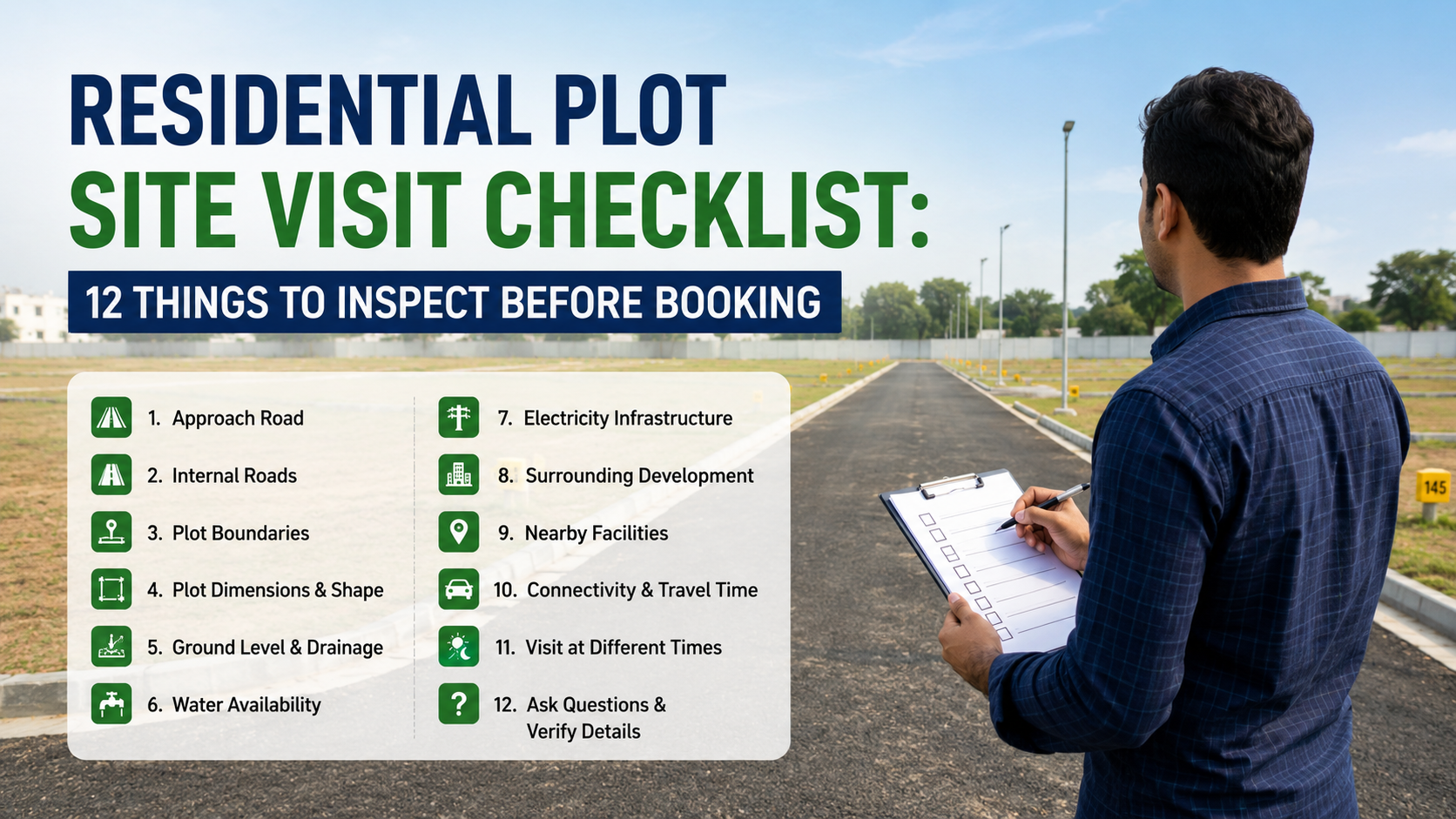
Buying a residential plot is a significant decision, especially when the intention is to build a home in the future. While online listings, brochures and property details can provide useful information, visiting the actual site gives buyers a better understanding of the location and its surroundings.
A site visit allows you to look beyond the advertised features and assess whether the plot is genuinely suitable for your plans. From road access and plot boundaries to drainage, surrounding development and basic infrastructure, several practical factors deserve attention before booking.
Here is a simple 12-point residential plot site visit checklist to help prospective buyers make a more informed decision.
Start by checking how easily you can reach the property. Look at the condition and width of the main approach road and consider whether cars and other vehicles can access the location comfortably.
A good approach road can make everyday travel more convenient and can also be important during future house construction when materials and equipment need to reach the site.
Once you enter the layout, check the condition and width of the internal roads.
Look for:
Well-planned internal roads can contribute significantly to the convenience of living in a plotted development.
Do not rely only on a brochure or site plan. During your visit, identify the actual location of the plot and compare it with the details provided by the developer.
Check the plot number, dimensions and boundary markers where available. If necessary, ask the concerned representative to show you the exact boundaries.
This is particularly important when comparing multiple plots within the same development.
The total area of a plot is important, but its dimensions and shape can be equally significant.
A plot with practical frontage and depth may provide greater flexibility when planning:
Think about how the plot could accommodate your intended house rather than looking at the square footage alone.
Observe the physical condition of the land during your visit.
Check whether the plot appears level with the surrounding roads and properties. Also look for signs of stagnant water, poor drainage or water accumulation in nearby areas.
Good drainage planning can become particularly important during heavy rainfall. Understanding the natural slope and surrounding drainage arrangements can help you identify potential concerns before purchasing.
Water is one of the most important requirements for any future home.
Ask about the source of water planned or available within the development. Depending on the project, this may include borewell, municipal or other approved water arrangements.
Do not simply assume that water availability will be the same as what you currently observe during a site visit. Ask for clear details about the planned infrastructure.
Check whether electricity infrastructure is already available or planned for the development.
Look for nearby electrical poles, connections and other visible infrastructure. Ask the developer about the process and availability of electricity connections for individual plots.
Having essential utilities planned in advance can make future construction more convenient.
Spend some time looking beyond the plot itself.
Check whether the surrounding area consists of:
A site visit gives you a better understanding of the neighbourhood than photographs or online maps alone.
Consider how far you would need to travel for everyday requirements.
During your visit, identify the approximate distance to schools, hospitals, supermarkets, banks, public transport and other essential facilities.
This becomes particularly important if you plan to construct a house and settle in the area rather than treating the plot purely as an investment.
Don't just check the distance to a major road. Test the actual route.
If possible, visit the location from your home, workplace or other frequently travelled destination. This gives you a realistic idea of travel time and road conditions.
For buyers exploring Residential Plots in Sriperumbudur, evaluating connectivity to Chennai and nearby employment and residential hubs can be an important part of the site visit.
A location can feel very different depending on the time of day.
If practical, visit once during the daytime and, preferably, again during the evening. This can help you understand:
A second visit can sometimes reveal details that are not obvious during the first inspection.
Use the site visit as an opportunity to clarify all important questions.
Ask the developer or authorised representative about:
It is advisable to verify important claims through the relevant documents rather than relying solely on verbal assurances.
One of the most common mistakes buyers make is concentrating only on the individual piece of land.
A residential plot is part of a larger environment. The approach road, internal infrastructure, drainage, utilities, neighbouring development and surrounding facilities can all influence how convenient the property will be in the future.
This is why a physical site visit should be an important part of your property-buying process.
When visiting multiple properties, it can become difficult to remember the details of each location.
Take photographs of the approach road, internal roads, surrounding area and the plot itself, where permitted. You can also note down important observations such as travel time, nearby facilities and questions that require clarification.
Comparing these notes later can make the decision-making process easier.
A good site visit does not replace legal and document verification.
Before finalising a purchase, buyers should independently verify the relevant property documents, approvals, ownership details and registration requirements with qualified professionals or the appropriate authorities.
The physical condition of a plot and the legal status of the property are two separate aspects, and both deserve careful attention.
A residential plot may look attractive on paper, but a physical inspection can reveal important details that are difficult to understand from photographs or online listings.
Checking road access, plot dimensions, drainage, utilities, surroundings, connectivity and nearby facilities can help you assess whether the property matches your future requirements.
If you are considering buying residential land in Chennai's growing suburban corridors, take time to visit the site, ask questions, compare options and complete the necessary document verification before making a commitment.
Explore Residential Plots in Sriperumbudur to learn more about available residential plot opportunities, or visit the Premier Housing for more property developments and information.
Premier Housing & Properties
No 11, NRD Tower, 3rd Floor,
Jawaharlal Nehru Road,
Ashok Nagar, Chennai - 600 083.