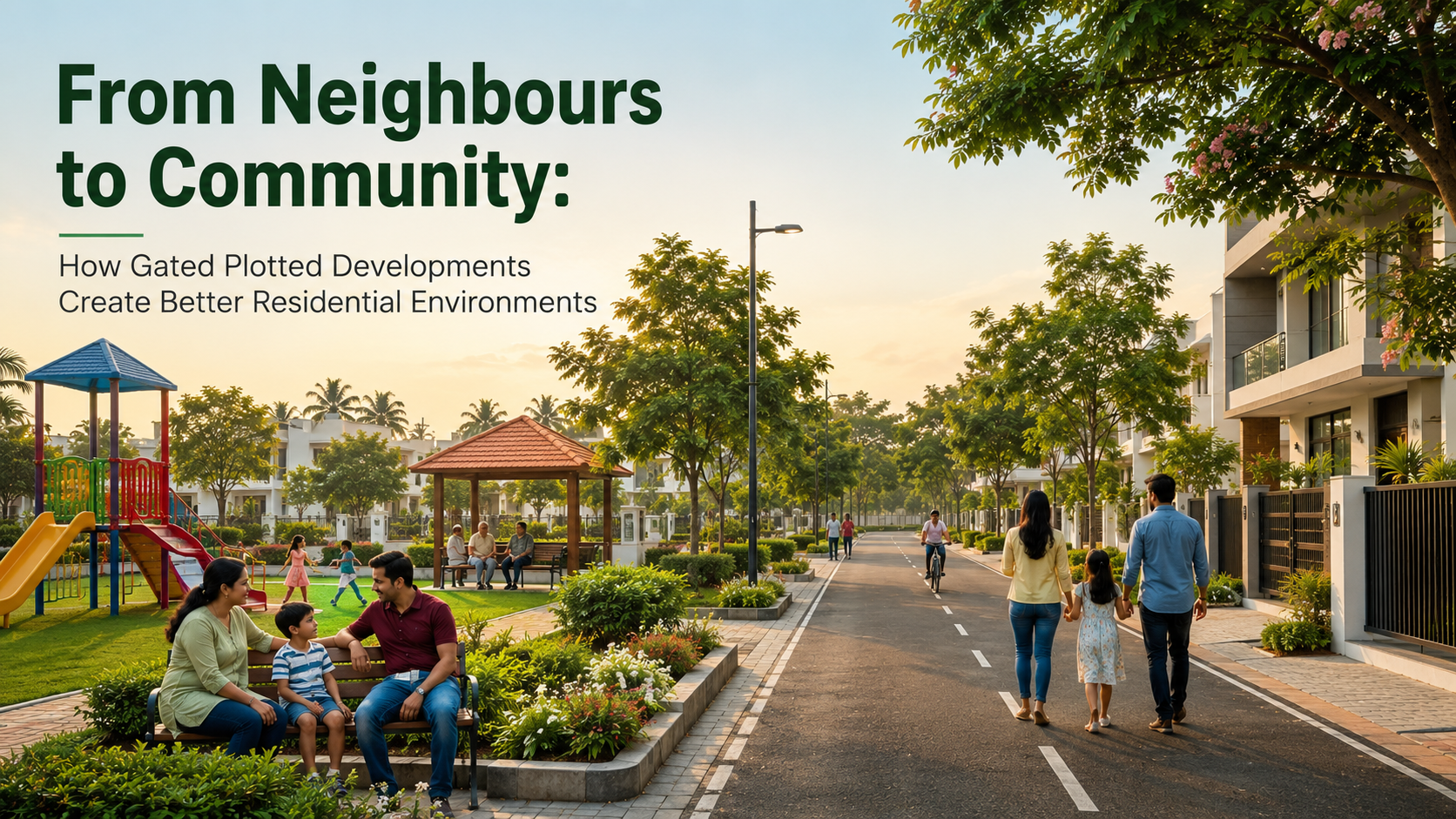
A home is more than the four walls surrounding a family. The people living around it, the streets children play on, the spaces where neighbours meet and the overall environment can have an equally important role in shaping everyday life.
This is one reason why gated plotted developments are gaining attention among homebuyers in Chennai. Instead of purchasing an isolated piece of land, families can become part of a planned residential environment where individual plots gradually develop into a connected neighbourhood.
A plotted community can begin with roads, greenery, lighting and essential infrastructure, but over time, it can become something more meaningful — a community shaped by the families who choose to live there.
When people purchase individual plots in an unplanned area, their surroundings may develop differently over time. Roads, open spaces and neighbouring properties may not follow a consistent residential vision.
A planned plotted development offers a different starting point.
Plots are organised within a defined layout, with common infrastructure and a planned road network. As more families construct their homes, an empty layout can gradually transform into a residential neighbourhood.
This creates an interesting transition:
Plot → Home → Neighbourhood → Community
The physical infrastructure provides the foundation, while the residents themselves give the neighbourhood its character.
Good neighbours can make everyday living more comfortable and connected.
A friendly greeting during an evening walk, children meeting their friends nearby or families exchanging a few words during a weekend can create small but valuable social connections.
For families, these interactions can become particularly meaningful.
Children can grow up knowing other families in their neighbourhood. Parents can develop local social connections. Senior citizens can enjoy a more familiar environment rather than feeling isolated.
These simple interactions can gradually transform a collection of houses into a community.
The design of a residential environment can influence how people use the space around their homes.
Well-planned internal roads, greenery and common areas can make residents more comfortable stepping outdoors for a walk, spending time with their children or interacting with neighbours.
In a plotted development, homeowners also have the opportunity to design their individual homes around their lifestyle while remaining part of a larger planned environment.
One family may create a small garden, another may design a spacious entrance, while another may prioritise a terrace or outdoor sitting area.
Over time, these individual choices contribute to the personality of the neighbourhood.
For families with children, the surrounding neighbourhood can be almost as important as the house itself.
Children benefit from opportunities to play, interact with other children and spend time outdoors. A planned residential community can provide a more structured environment for these everyday experiences.
Instead of every activity happening indoors, children can develop a connection with their surroundings and build friendships within the neighbourhood.
Features such as children's play areas and thoughtfully planned open spaces can therefore contribute to the overall residential experience.
Some homebuyers may associate community living with a lack of privacy. A plotted development can offer a balance between the two.
Each family owns its individual plot and can design its home according to its requirements. At the same time, residents share the benefits of a planned neighbourhood and common infrastructure.
This combination can provide:
For families looking for both independence and community, this balance can be an important consideration.
A residential area feels different when greenery is incorporated into its planning.
Trees along roads, landscaped areas and gardens around individual homes can gradually create a pleasant visual environment as the community develops.
Green surroundings can also encourage residents to spend more time outdoors. An evening walk can become part of a daily routine, while families may enjoy sitting outside their homes or maintaining their own gardens.
Infrastructure may seem purely functional, but it can influence how residents experience a neighbourhood.
Roads make movement easier. Street lighting supports comfortable movement after sunset. Water infrastructure supports everyday household needs. Open and recreational areas provide opportunities for families to spend time outside.
When these elements are planned together, they contribute to a more cohesive residential environment.
This is one of the differences between simply owning land and becoming part of a planned plotted community.
A new plotted development may initially have only a few completed homes. The surroundings can therefore look very different during the early stages.
As more plot owners construct their houses and move in, the character of the neighbourhood changes.
A typical progression may look like this:
Stage 1: Plots and basic infrastructure are established.
Stage 2: The first families begin constructing their homes.
Stage 3: More houses emerge and neighbourhood activity increases.
Stage 4: Children begin forming friendships and families develop social connections.
Stage 5: The layout evolves into an established residential community.
This gradual development is one of the unique characteristics of plotted communities.
When evaluating a residential plot, buyers often concentrate on dimensions, price and location. These are important, but the broader residential environment deserves attention too.
Ask questions such as:
Thinking beyond the individual plot can help buyers make a more informed decision.
For readers researching the broader benefits of purchasing residential land, our related guide on planning your budget before buying a residential plot in Chennai can also be useful.
Located at Nedugundram Village, Perungalathur, Aishwaryam Garden is a 16-acre gated plotted development from Premier Housing & Properties.
The development incorporates features such as concrete roads, avenue trees, street lighting, potable water and a children's play area. These elements provide the infrastructure needed for individual plots to gradually become part of an organised residential environment.
As homeowners build their properties and families begin occupying the community, the development can evolve beyond individual plots into a connected neighbourhood.
Infrastructure can create the framework for a residential development, but people create its identity.
The families who purchase homes, children who make friends, neighbours who interact and residents who care about their surroundings collectively shape the character of a community.
That is why the idea of a gated plotted development can be about more than land ownership.
It can be about choosing where your family wants to live, the kind of neighbourhood you want to experience and the community you want to help create.
A good residential environment is not built only with roads and houses. It is built through the everyday connections between the people who call it home.
If you are looking for a thoughtfully planned residential plot where your future home can become part of a growing neighbourhood, Aishwaryam Garden by Premier Housing & Properties offers an opportunity to plan your family's next chapter in Perungalathur.
Explore Aishwaryam Garden and discover a place where a plot can become the starting point for a home, a neighbourhood and a community.
Premier Housing & Properties
No 11, NRD Tower, 3rd Floor,
Jawaharlal Nehru Road,
Ashok Nagar, Chennai - 600 083.